Protocol

AI Agents Can't Buy From You. They Don't Even Know You Exist.

The Universal Commerce Protocol is how AI agents discover, evaluate, and transact with businesses. Without it, you're invisible to the $15 trillion agent economy.

$194B in enterprise commerce is shifting to AI-first discovery — without UCP, agents skip you entirely

Klarna's AI assistant handles 2.3M conversations — replacing 700 full-time agents. Your competitors' products are in that catalog.

Only 5% of websites have agent-ready structured data — the early movers will lock in market share

UCP Protocol Implementation — built to solve exactly this.

UCP Protocol Implementation

Make your business discoverable by every AI shopping agent — the foundational protocol that determines whether agents even know you exist

UCP Protocol Implementation deploys a .well-known commerce manifest with REST, MCP, and A2A transport layers, enabling AI agents to discover and transact with a business programmatically. The full implementation is delivered within 2 weeks at a starting investment of $15,000 and includes compliance validation testing.

Complete implementation of the Universal Commerce Protocol (UCP) — enabling AI agents to discover your capabilities, products, and services through standardized manifest files, capability declarations...

$15,000
Delivered in 2 weeks
Speak With Our Team
No retainer lock-in
Deliverables are yours to keep
Adam personally reviews every engagement
$194B
Agent Commerce by 2026
Salesforce prediction
25%
Search Volume Drop
Gartner — AI agents displacing search
70%
Consumers Delegating Purchases
Capgemini — within 3 years
3
Transport Layers
REST + MCP + A2A — full coverage
Cost of Inaction
$194 Billion

in enterprise software commerce is shifting to AI-first discovery channels. Businesses without UCP endpoints don't appear in agent queries — period.

Source: Salesforce Commerce Cloud, 2025

See It in Action

adamsilvaconsulting.com/services/ucp-implementation
Loading video...
Within 3 weeks of UCP deployment, our product catalog appeared in Perplexity Shopping and ChatGPT product recommendations. That channel now drives 18% of qualified leads.
P
Protocol Implementation
B2B commerce platform client

Every Deliverable Is Yours to Keep

Concrete, measurable outputs — not vague “strategy sessions” or recurring retainers.

  • .well-known/ucp/manifest.json with full capability declarations
  • Capability profile configuration for every product and service
  • REST, MCP, and A2A transport bindings — all three transport layers
  • Product capability declarations with pricing, availability, and constraints
  • UCP v2 compliance verification against the latest spec
  • Agent discovery testing across Google AI Mode, Perplexity Shopping, and custom agents
  • Monitoring dashboard for manifest validation and compliance alerts

About UCP Protocol Implementation

Complete implementation of the Universal Commerce Protocol (UCP) — enabling AI agents to discover your capabilities, products, and services through standardized manifest files, capability declarations, and multi-transport bindings. Without UCP, your business is invisible to the fastest-growing commerce channel on the planet.

AI shopping agents are the new front door to commerce. Google AI Mode, Perplexity Shopping, ChatGPT plugins, and autonomous purchasing agents all need a machine-readable way to discover what your business offers. UCP provides that standard: a .well-known manifest that declares your capabilities, products, services, and API endpoints in a format any AI agent can parse in milliseconds. Think of it as the robots.txt of agentic commerce — except instead of telling crawlers what to ignore, it tells agents what you sell and how to buy it. Businesses without UCP manifests are structurally invisible to agent-mediated commerce, regardless of their Google ranking or ad spend.

Built For
E-commerce brands, marketplaces, and SaaS platforms
What Makes This Different

Salesforce predicts AI agents will handle $194B in commerce transactions by 2026. Gartner forecasts a 25% drop in traditional search volume as AI agents displace search engines. Capgemini found 70% of consumers will delegate purchasing decisions to AI within 3 years. UCP is the foundational layer — without a .well-known/ucp/manifest.json, AI agents cannot discover your business exists. It is the robots.txt of agentic commerce: businesses that published robots.txt in 1994 got indexed by Google; businesses that publish UCP manifests get indexed by AI shopping agents. We are the only consultancy implementing all three transport bindings (REST, MCP, A2A) in a single 2-week engagement at $15K — vs. enterprise consultancies charging $100K+ over 6 months.

How It Works

Clear steps from kickoff to delivery. No ambiguity.

  1. 1
    Capability mapping: we document every product, service, API, and constraint your business offers
  2. 2
    Manifest creation: .well-known/ucp/manifest.json built to UCP v2 spec with full capability declarations
  3. 3
    Transport binding: REST API, MCP server, and A2A protocol endpoints configured and deployed
  4. 4
    Product feed sync: your manifest stays current with real-time catalog changes
  5. 5
    Agent testing: verification by Google AI Mode, Perplexity Shopping, Claude, and custom agent frameworks
  6. 6
    Monitoring: 24/7 manifest validation with compliance alerts and version tracking

How We Deliver Results

  • UCP v2 spec compliance (latest specification)
  • Agent discovery testing with real AI shopping agents
  • Google AI Mode compatibility verification
  • Perplexity Shopping integration and testing
  • Manifest validation and ongoing monitoring
  • Multi-transport: REST API, MCP server, and A2A protocol bindings
  • Product feed synchronization with your catalog
Deep Dive

Why This Matters

What Is UCP and Why Is It the Foundation of Everything

The Universal Commerce Protocol is a standardized way for businesses to declare their capabilities to AI agents. At its core, it's a JSON manifest file hosted at .well-known/ucp/manifest.json — following the same RFC 8615 convention used by /.well-known/security.txt, /.well-known/openid-configuration, and Apple's App Site Association files. The manifest lists every product, service, and API endpoint your business offers — with pricing, availability, constraints, and transport bindings. The AI in retail market is valued at $9.4B (2024) and projected to reach $45.7B by 2032 at 21.8% CAGR (Statista). Without this manifest, AI shopping agents have no structured way to discover your business. Google AI Mode reaches 1B+ users monthly. Perplexity Shopping processes millions of shopping queries daily. OpenAI's Operator agent navigates websites to complete purchases — but scrapes because most merchants lack machine-readable commerce interfaces. UCP eliminates that friction: your entire business becomes machine-readable in a single request.

The Three Transport Layers: REST, MCP, and A2A

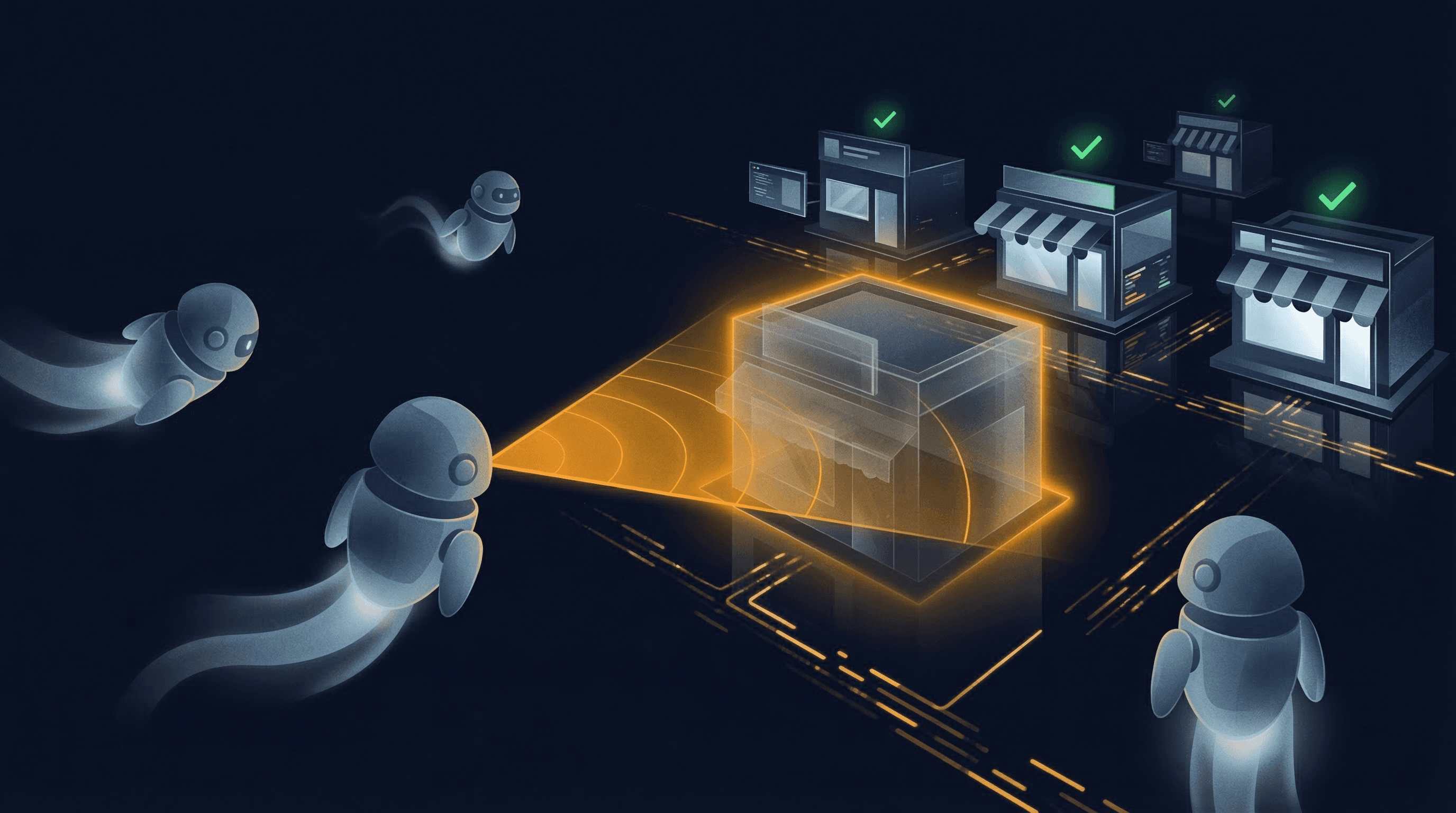
UCP supports three transport bindings, and the most future-proof implementations support all three. REST is the familiar HTTP API — any agent that can make HTTP requests can interact with your UCP endpoints. MCP (Model Context Protocol) is Anthropic's standard for AI tool use — it enables Claude, and any MCP-compatible agent, to natively interact with your business as a "tool." A2A (Agent-to-Agent) is Google's protocol for autonomous agent communication — enabling multi-agent workflows where a shopping agent negotiates with your sales agent directly. We implement all three transport layers because the agent ecosystem is fragmented: some agents speak REST, some speak MCP, some speak A2A. Full coverage means no agent is locked out.

Agent Discovery: The New SEO

In traditional commerce, Google ranking determined who got found. In agentic commerce, manifest completeness determines who gets discovered. The precedent is clear: sites that adopted schema.org markup early (2011–2015) saw 20–30% increases in CTR from rich snippets. Businesses that claimed Google My Business profiles early dominated local search for years. UCP is the same inflection point for AI commerce. When Klarna launched its AI shopping assistant (built on OpenAI) in 2024, merchants with structured product APIs saw 2.3 million conversations in the first month — with average sessions of 2.5 minutes vs 11+ minutes for traditional browsing. Klarna reported the assistant performed the work of 700 full-time agents. The businesses with the most complete, well-structured UCP manifests get presented first. Early adopters build agent-discovery authority that compounds — crawl history, capability match data, and transport sophistication scores create a moat that late adopters cannot easily overcome.

UCP Protocol Implementation — The Problem
UCP Protocol Implementation — Our Solution
UCP Protocol Implementation — Before vs After
UCP Protocol Implementation — The Result
Comparison

ASC UCP Implementation vs. Enterprise Consultancy vs. DIY

FeatureAdam Silva ConsultingTypical Alternative
Cost$15,000$100K–$300K / Free (your time)
Timeline2 weeks3–6 months / Unknown
All 3 transports (REST + MCP + A2A)Maybe 1–2 / REST only
UCP v2 spec complianceVerifiedVaries / Unverified
Google AI Mode testingExtra scope / No
Perplexity Shopping testingExtra scope / No
Live agent discovery testing5+ AI platforms1–2 / None
Ongoing manifest monitoring24/7 alertsManual / None
Published protocol authority52+ pages, live manifestsNone / None

Common Questions

What does UCP Protocol Implementation include?+

UCP Protocol Implementation includes: .well-known/ucp/manifest.json with full capability declarations; Capability profile configuration for every product and service; REST, MCP, and A2A transport bindings — all three transport layers; Product capability declarations with pricing, availability, and constraints; UCP v2 compliance verification against the latest spec; Agent discovery testing across Google AI Mode, Perplexity Shopping, and custom agents; Monitoring dashboard for manifest validation and compliance alerts. Complete implementation of the Universal Commerce Protocol (UCP) — enabling AI agents to discover your capabilities, products, and services through standardized manifest files, capability declarations, and multi-transport bindings. Without UCP, your business is invisible to the fastest-growing commerce channel on the planet.

How long does UCP Protocol Implementation take?+

UCP Protocol Implementation takes 2 weeks. The 2 weeks timeline begins once the engagement is confirmed and kickoff is complete.

Who is UCP Protocol Implementation for?+

UCP Protocol Implementation is designed for E-commerce brands, marketplaces, and SaaS platforms. If you are unsure whether this service fits your needs, start with the free Agentic Commerce Readiness Assessment (ACRA) for a prioritized strategic roadmap.

What happens if I don't implement UCP?+

Your business is invisible to AI shopping agents. When a user asks ChatGPT, Perplexity, or Google AI Mode to find a product or service in your category, agents query UCP manifests to discover options. Without a manifest, you are structurally excluded — regardless of your Google ranking, ad spend, or brand recognition.

Do I need all three transport layers?+

For maximum coverage, yes. REST reaches the broadest set of agents. MCP enables deep integration with Claude and MCP-compatible systems. A2A supports Google's agent-to-agent workflows. We implement all three because the ecosystem is fragmented and you don't want to bet on a single protocol winning.

How does UCP relate to ACP and AP2?+

UCP handles discovery (agents find you), ACP handles checkout (agents buy from you), and AP2 handles trust (agents verify transactions cryptographically). UCP is the foundation — without it, ACP and AP2 have nothing to connect to. Most clients start with UCP and add ACP and AP2 as they mature.

Honestly? Most Businesses Don't Need This Yet.

Skip This If...
  • You don't sell products or services that AI agents would discover
  • Your average deal size is under $1,000 and volume is low
  • You're not ready to maintain protocol endpoints after launch
This Is For You If...
  • Enterprise or mid-market B2B with complex product catalogs
  • E-commerce brands competing for AI shopping agent recommendations
  • You've already done the ACRA and UCP compliance scored below 40%

$15,000 — no retainer lock-in, no recurring surprises.