The Agentic Commerce Shift Is Here: What SMBs Need to Know Now
AI agents are already discovering, comparing, and buying on behalf of customers who never touch your website. For small and midsize businesses, that shift is not optional homework. It is the new front door to commerce, and most SMBs have not opened it yet.
Every business owner I talk to is still measuring competition the old way: website traffic, ad spend, keyword rank. Meanwhile, the customer they are trying to reach has started delegating the shopping itself to an AI agent that may never visit their website at all. That is not a forecast. It is happening right now, inside your industry, whether your business has noticed or not.
Gartner projects that 90% of B2B purchases will flow through AI agents by 2028. Salesforce data from Cyber Week 2025 already showed AI agents influencing $67 billion in global orders, 20% of all transactions in a single week. Capgemini found 82% of enterprises plan to integrate AI agents within one to three years. And McKinsey's research is the sentence that should worry every small business owner most: almost no retailers, of any size, are actually prepared.
What Is the Agentic Commerce Shift, and Why Is It Different From the Last Platform Shift?
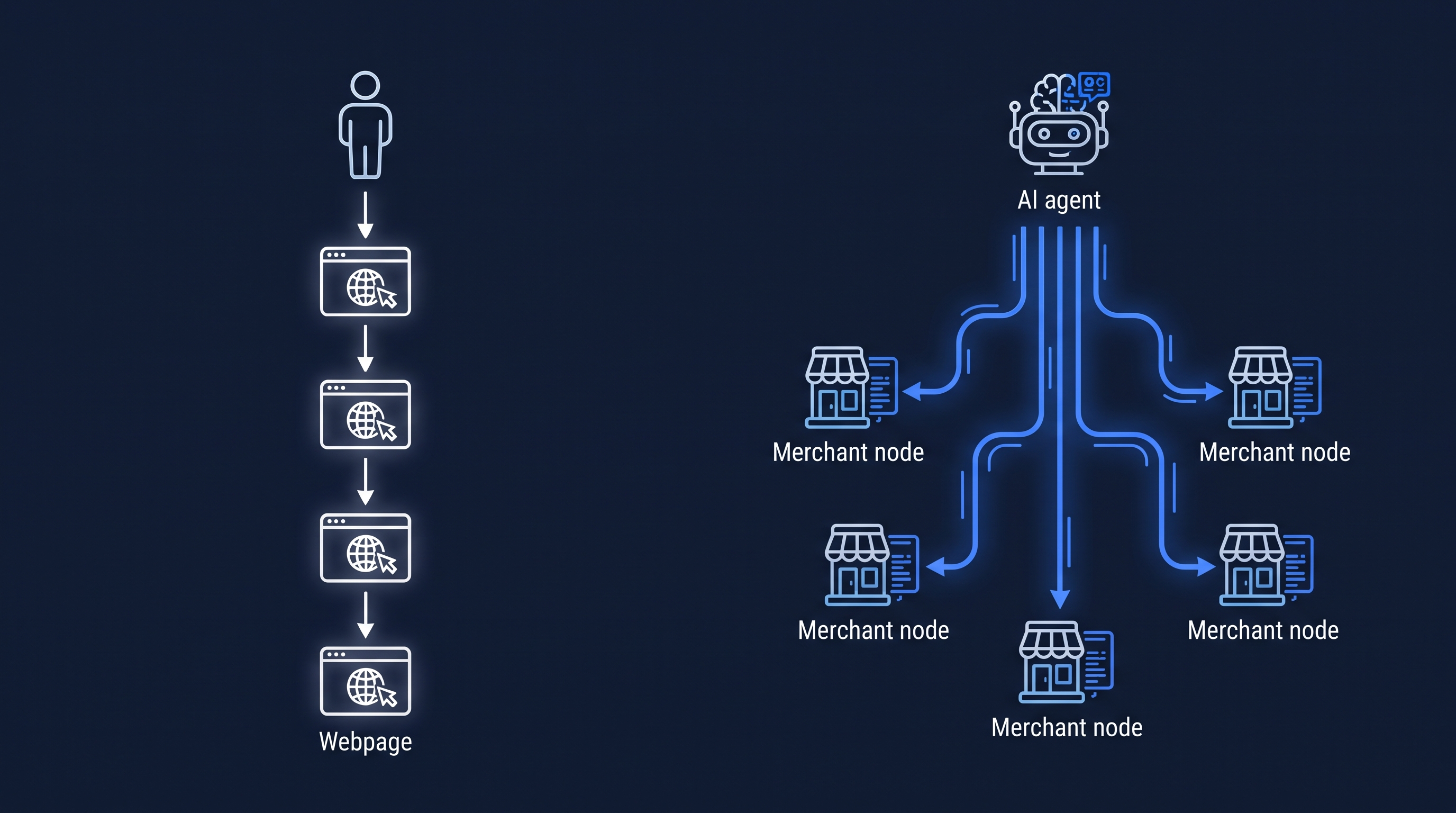
The agentic commerce shift is the move from humans browsing websites to AI agents discovering, comparing, and transacting with businesses directly. Unlike mobile or social, which added a new channel, this shift replaces the decision-maker itself: the AI agent, not the person, decides which businesses even get considered.
Every platform shift of the last twenty years (desktop to mobile, search to social, banner ads to programmatic) added a new surface for humans to interact with. The agentic shift is structurally different. It replaces part of the human decision-making process itself. When a customer asks an AI agent to "find a reliable HVAC company nearby with good reviews" or "compare consulting firms that specialize in AI readiness," the agent does the discovery, the comparison, and increasingly the negotiation, before a human ever sees a website.
That means the old scoreboard of rankings, click-through rate, and time on page is measuring an audience that is shrinking. The new scoreboard is binary: can an AI agent find your business, verify what you offer, and trust the data enough to recommend or transact with you? If the answer is no, you are not ranked lower. You are simply not in the conversation.
Why Are Small and Midsize Businesses the Most Exposed to This Shift?
SMBs are more exposed than enterprises because most enterprise platforms are already rebuilding for agentic commerce with dedicated engineering teams, while SMBs typically have a website built for humans, no structured data strategy, and no one tracking the shift at all.
Large platforms are not waiting. Google's Universal Commerce Protocol (UCP) and OpenAI's Agentic Commerce Protocol (ACP) with Instant Checkout are being built into the infrastructure that Fortune 500 companies already have engineering teams dedicated to integrating. That is the game most SMB owners assume is being played somewhere else, by someone else, later.
It is not later. It is now, and it is more dangerous for a small business precisely because a small business has fewer channels to fall back on. An enterprise with a national ad budget can absorb a slow AI-visibility transition. A regional HVAC company, a boutique consulting firm, or a local service business that depends on being found for one or two high-intent searches per day cannot. When the AI agent that would have found you instead finds a competitor with a structured, machine-readable presence, that lead does not come back.
What Does "AI-Ready" Actually Mean for a Business That Isn't a Fortune 500?
For an SMB, AI-ready means three concrete things: your business is described in structured data an agent can parse, your authority signals are consistent and verifiable across the web, and your content answers the direct questions AI systems are trying to resolve. It does not mean you have rebuilt your entire technology stack.
This is where most business owners get the scope wrong. They hear "agentic commerce" and picture a six-month, six-figure infrastructure project reserved for companies with a CTO and an engineering budget. That is not the SMB starting point, and it should not be.
The SMB starting point is an assessment: where does your business currently stand against the protocols and signals AI agents actually use? UCP-style discovery data, ACP-style transaction readiness, schema.org structured markup, authority and trust signals, and content built to answer questions directly rather than to rank for keywords. Most small businesses have never had this measured. They are flying blind against a system that is already deciding whether they exist.
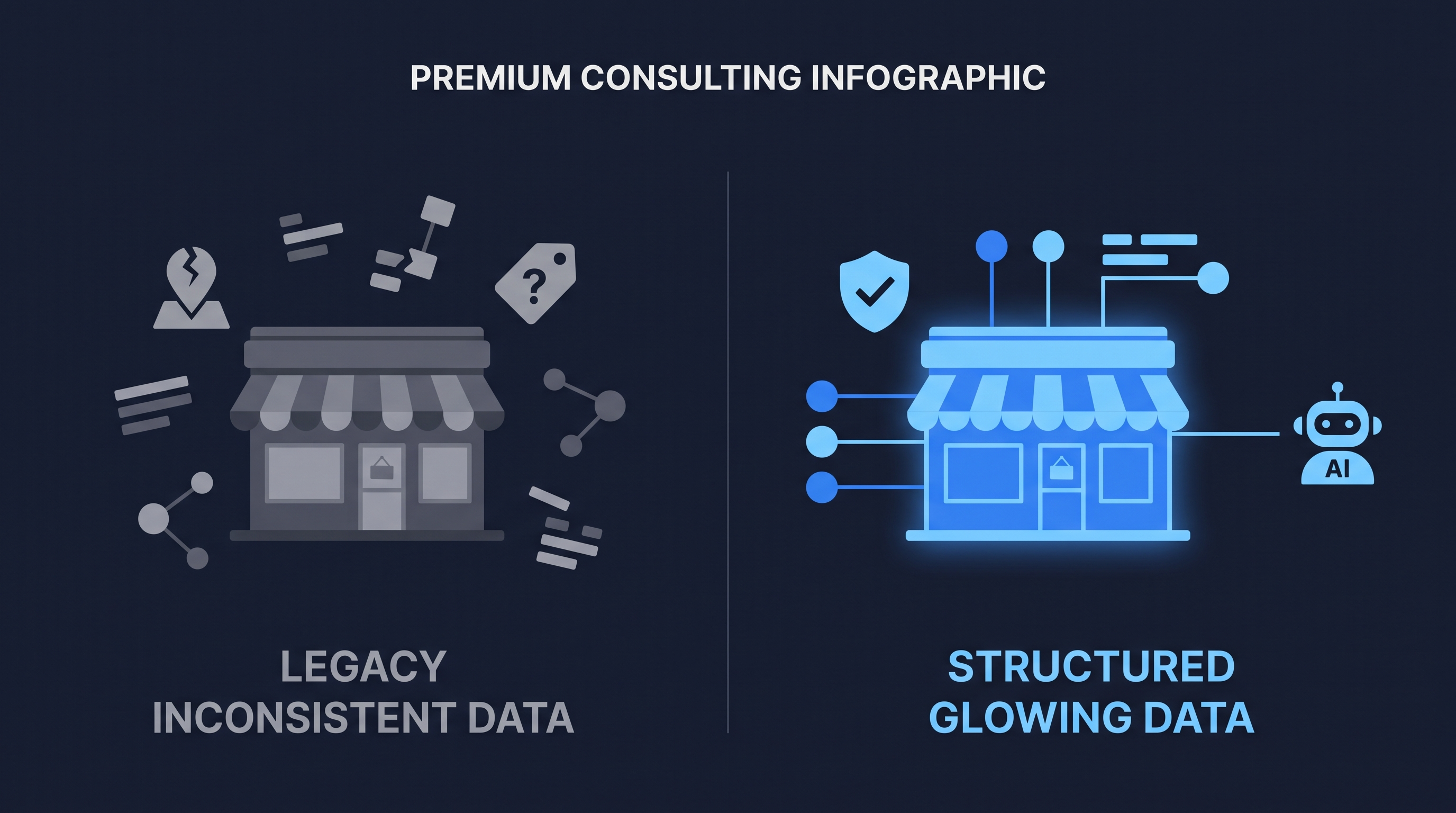
| Signal | Legacy SMB | Agentic-Ready SMB |
|---|---|---|
| Structured data | None, or a single generic schema tag | Full schema.org markup + UCP-style capability manifest |
| Content format | Keyword-optimized pages written for rank | Direct-answer content written for AI citation (AEO/GEO) |
| Trust signals | Scattered, inconsistent NAP across directories | Corroborated identity an agent can verify in milliseconds |
| Discoverability to agents | Effectively invisible | Eligible for discovery, comparison, and citation |
Why Is SEO Turning Into AEO and GEO, and What Actually Changes?
SEO optimized for ranking algorithms that a human would scroll through. AEO and GEO optimize for AI systems that extract a direct answer and cite a source without ever showing the reader a list of links. Zero-click behavior is now the default, not the exception.
Zero-click search has already crossed 69% of Google queries, and AI Overview results are pushing past 83% zero-click on informational queries. That means the majority of the traffic a small business used to fight for never lands on a page at all. The AI system reads the page, extracts the answer, and shows it directly to the user, with or without a citation, depending entirely on whether that page was structured to be extractable.
This is the practical difference between SEO and AEO/GEO. SEO asks "how do I rank higher." AEO and GEO ask "how do I become the source an AI system trusts enough to cite by name." The tactics change: direct-answer paragraphs immediately under every heading, structured data that declares who you are and what you know, and authority signals (reviews, citations, consistent presence) that give an AI system a reason to attribute a claim to you instead of a nameless aggregation of the web.
“The businesses that win the next five years will not be the ones who shout the loudest. They will be the ones an AI agent can verify fastest: clean data, consistent trust signals, and content built to answer a question in one pass, not to be scrolled through.”
Adam Silva, Founder, Adam Silva Consulting
Why Does Data Quality Decide Whether an AI Agent Trusts You at All?
AI agents do not extend the benefit of the doubt. An agent that finds conflicting business hours, mismatched addresses, or unstructured pricing will simply route around a business rather than resolve the ambiguity. Data quality is not a technical nicety. It is the trust layer the entire agentic transaction depends on.
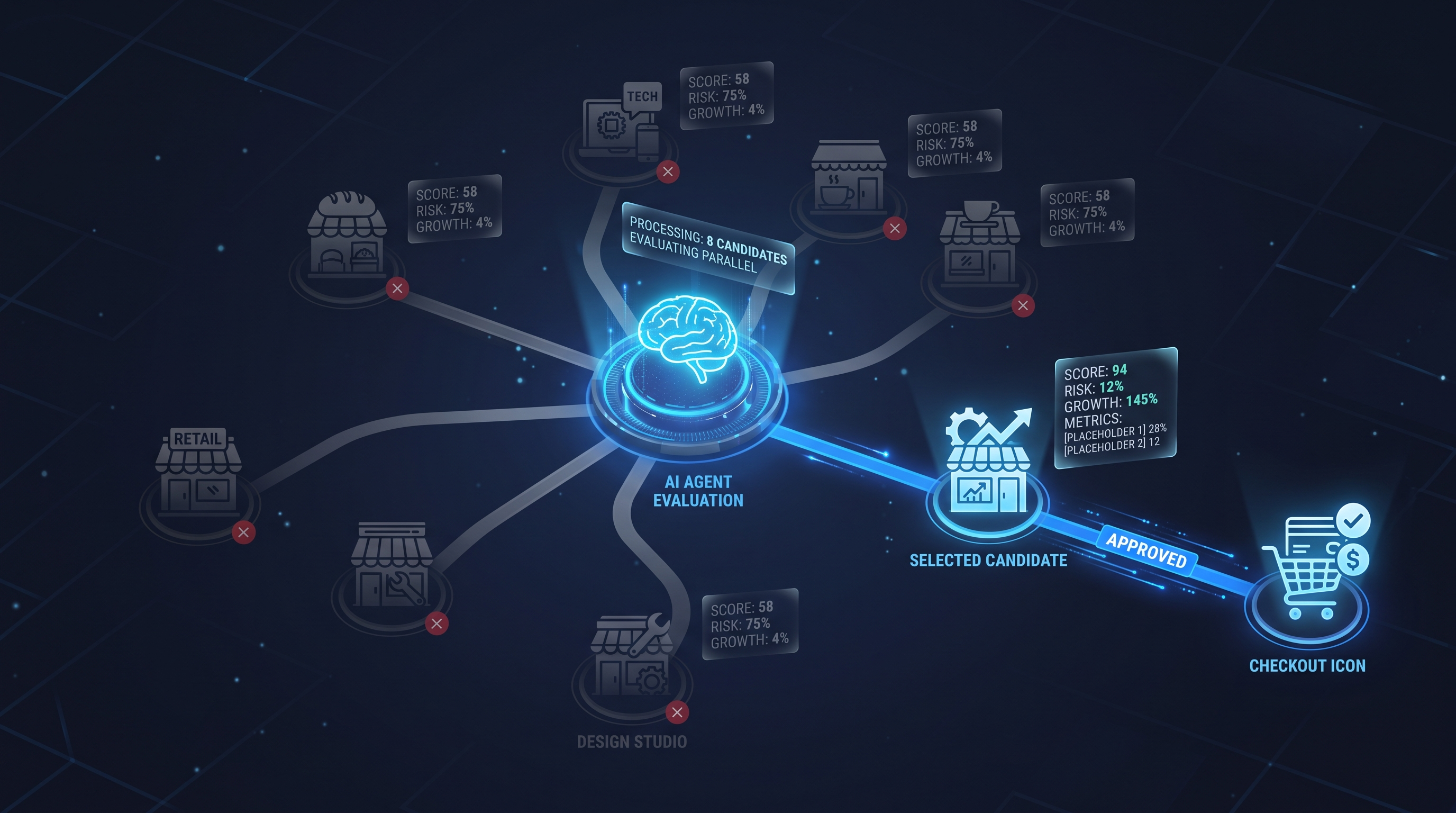
A human visitor who finds a typo or an outdated phone number on your site will usually forgive it, or call anyway. An AI agent has no such patience. It is evaluating dozens of candidate businesses in the time it takes a human to read one sentence, and it discards ambiguity by default. Inconsistent name-address-phone data across directories, missing structured pricing, undeclared service areas: every one of these gaps is a reason for the agent to move to the next result rather than resolve the conflict in your favor.
This was one of the core threads Dr. A.J. Stalker and I unpacked with host Paula Chiocchi on the B2B Influence podcast: the businesses treating data quality as an IT afterthought are the ones that will be quietly filtered out of AI-driven recommendations, with no error message and no warning. The agent does not tell you it passed you over. It just does.
What Should an SMB Actually Do First?
Start by measuring, not building. An SMB does not need a UCP manifest, an ACP checkout layer, and a content overhaul launched simultaneously. It needs a prioritized map of which gaps are costing it discovery today, so the first dollar spent closes the highest-value gap first.
The five moves, in order:
- Measure where you stand. A structured agentic-readiness assessment that names the exact gaps before a dollar is spent on infrastructure.
- Fix the structured data. Complete schema.org markup for the business, its offers, its people, and its FAQs, then a UCP-style capability manifest.
- Make the trust signals consistent. One name, address, phone, set of hours, and service area everywhere they appear, so an agent can verify you in a single pass.
- Write for extraction. Direct answers under question headings, so answer engines and generative engines can cite you by name.
- Implement the protocols in priority order. UCP for discovery, ACP for checkout, AP2 for payment trust, starting with whichever one the assessment shows is your biggest exposure.
This is the sequencing mistake I see most often: a business owner reads one article about UCP, panics, and asks a developer to bolt on a manifest file with no idea whether that is even the highest-priority gap. Protocol implementation matters, but it is step three, not step one. Step one is knowing, specifically, where your business stands: which structured data is missing, which authority signals are inconsistent, which content gaps are costing you AI citations, and which of the three protocols (UCP, ACP, or AP2) represents your biggest exposure.
That is a bounded, inexpensive first move. It does not require a six-figure commitment or a new engineering hire. It requires an honest, structured assessment of where the gaps actually are, so that the infrastructure work that follows is solving the right problem first. For the mechanics of each protocol, the companion piece The Agentic Commerce Protocols: UCP, ACP, and AP2 goes layer by layer.
The Two Futures: Which One Will Your Business Be In?
One path leads to a business AI agents can discover, verify, and recommend with confidence. The other leads to a business that quietly stops appearing in the conversation at all: not ranked lower, simply absent, with no notification that it happened.
The infrastructure for agentic commerce is not a future event. UCP, ACP, and AP2 already exist. The protocols are published. The platforms are integrating them now, at enterprise speed. The only open question is which businesses close the gap before it compounds, and which ones spend the next three years wondering why the phone stopped ringing on leads that used to come in every week.
Small and midsize businesses do not need to out-build the platforms. They need to be legible to them: structured, consistent, and verifiable. That is a solvable problem, and it starts with knowing exactly where you stand today.
Last Fact-Checked & Metric-Verified: August 2026 · Sources cited inline with publication year
Frequently Asked Questions
What is the agentic commerce shift and why does it matter for small businesses?+
The agentic commerce shift is the move from human web browsing to AI agents discovering, comparing, and transacting with businesses on a customer's behalf. Gartner projects 90% of B2B purchases will flow through AI agents by 2028, and small businesses are more exposed than enterprises because most have no structured data strategy and fewer channels to fall back on if AI-driven discovery bypasses them.
How is AEO different from traditional SEO?+
Traditional SEO optimizes for ranking algorithms a human scrolls through. AEO (Answer Engine Optimization) and GEO (Generative Engine Optimization) optimize for AI systems that extract a direct answer and cite a source without showing a list of links. With zero-click search behavior above 69% of queries (SparkToro/Similarweb) and AI Overviews reaching 83% zero-click on informational queries, content built for extraction and citation now outperforms content built purely for rank.
What does "AI-ready" mean for a small or midsize business?+
For an SMB, being AI-ready means three concrete things: structured data an AI agent can parse (schema.org markup and protocol-level manifests), consistent and verifiable authority signals across the web, and content that answers direct questions rather than chasing keywords. It does not require rebuilding an entire technology stack. It starts with a prioritized assessment of the highest-value gaps.
Why does data quality matter so much for AI agent discovery?+
AI agents evaluate dozens of candidate businesses in the time a human reads one sentence, and they discard ambiguity by default. Inconsistent name-address-phone data, missing structured pricing, or undeclared service areas give an agent a reason to route around a business entirely, with no notification that it happened. Clean, consistent data is the trust layer the entire agentic transaction depends on.
What should an SMB do first to prepare for agentic commerce?+
Start with an assessment, not a rebuild. Before implementing UCP manifests, ACP checkout layers, or AP2 payment mandates, an SMB needs a prioritized map of where it currently stands: missing structured data, inconsistent authority signals, content gaps, and which of the three protocols represents the biggest exposure. ASC's Agentic Commerce Readiness Assessment delivers that map in 48 hours at /services/acra.
Related Articles
Sources & References
- Gartner — "Predicts 2025": 90% of B2B purchases will flow through AI agents by 2028Source
- Salesforce — Cyber Week 2025 data: AI agents influenced 20% of global orders ($67B) in a single weekSource
- Capgemini — Research on enterprise AI agent adoption: 82% plan integration within 1-3 yearsSource
- McKinsey & Company — Retail AI readiness research: almost no retailers are actually prepared for agent-driven commerceSource
- Google Developers Blog — Universal Commerce Protocol (UCP) specification for AI agent discoverySource
- OpenAI — Commerce documentation: Agentic Commerce Protocol (ACP) and Instant CheckoutSource
- schema.org — Structured data vocabulary adoption: under 30% of web pages carry any schema.org markupSource
- SparkToro / Similarweb — Zero-click search research: over 69% of Google searches now end without a clickSource