Why Google Maps Is the New Storefront for Multi-Location Franchise Brands
Google Maps has replaced the storefront window for multi-location franchise brands. Adam Silva explains why local ranking is won address by address, not brand by brand, and what corporate and local teams each need to own to keep every location visible, trusted, and converting foot traffic.
Google Business Profile is the free, owner-managed listing that decides whether a customer standing three miles from one of your locations finds it today, or finds a competitor instead, and roughly three out of four people who run that search on a phone walk into a business within 24 hours of running it. That is not a marketing statistic. That is the entire sales cycle for a multi-location franchise brand, compressed into one screen most corporate teams have never logged into.
For most of the last decade, franchise marketing treated Google Maps as an afterthought: claim the listing once, leave it alone, spend the real budget on the website and the paid campaigns. That posture is no longer defensible. The map is not a directory anymore. It is the first storefront a customer walks through, and for a multi-location brand, it renders a different verdict at every single address.
Understanding how that storefront actually works, and who inside the organization is responsible for keeping it accurate, has become a core operating requirement for any brand running more than one location.
What Is the Local 3-Pack, and Why Does It Decide Who Gets the Call?
The Local 3-Pack is the small group of map-based business listings Google displays above traditional web results whenever it detects local intent in a search, and on mobile it now functions as the decision screen, often before anyone reaches a website at all.
Picture someone standing next to a car with a flat tire. They pull out a phone and search "tire shop near me." They are not researching tire manufacturing history. They have a specific problem and they need a nearby answer immediately. Within seconds, Google returns a small cluster of businesses, each with a name, a star rating, hours, photos, a phone button, and a directions link. A decision can be made from that screen alone, before a single website ever loads.
That cluster is commonly called the Local Pack or Local 3-Pack. Google has been clear that the exact count and layout can vary by device, query, and location, but the underlying dynamic does not: customers act directly on what the map shows them. For a franchise brand, that means the 3-Pack is some of the most valuable digital real estate the company owns, and it is won or lost location by location, not brand by brand.
How Does Google Decide Which of Your Locations Wins the Search?
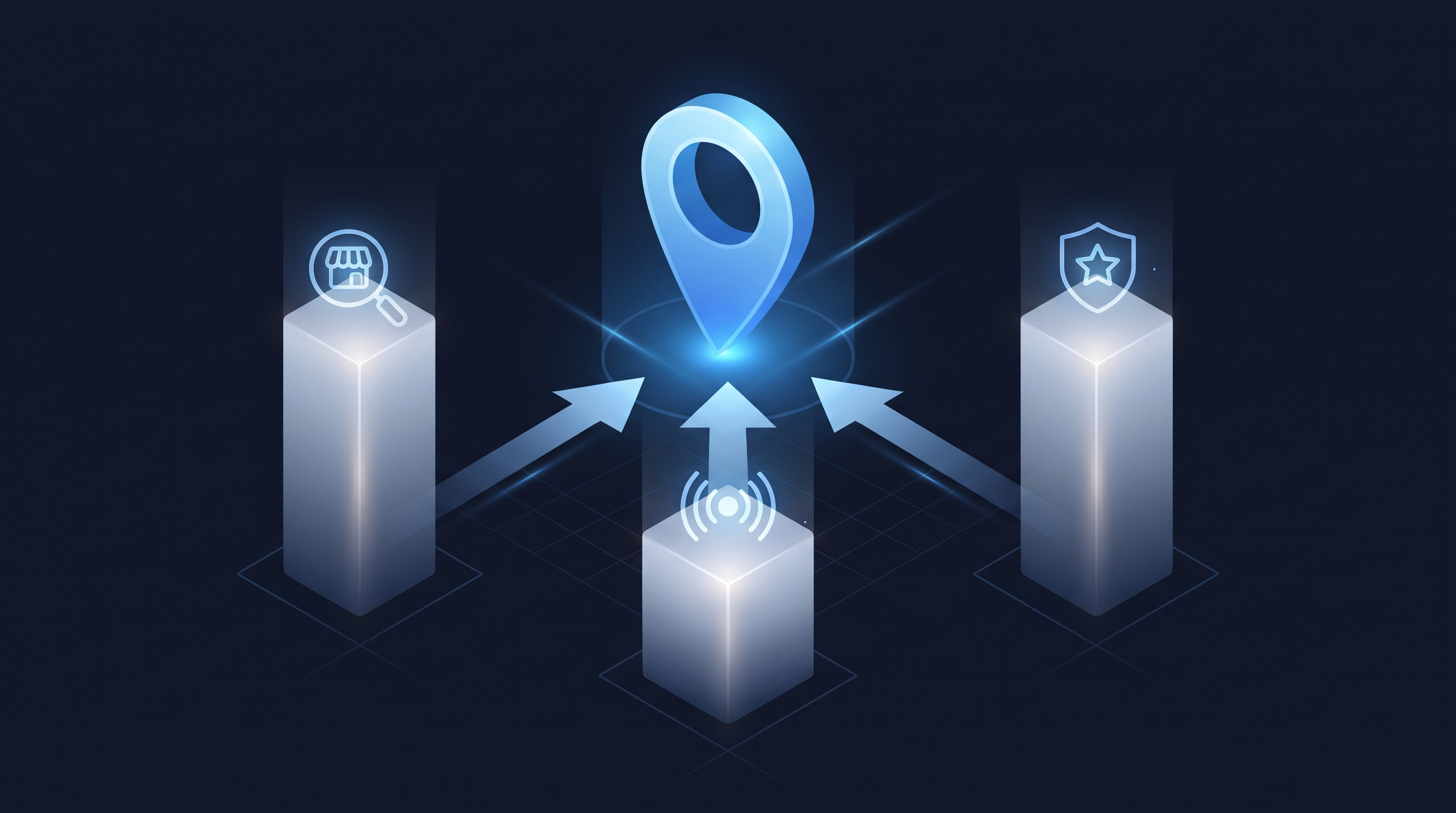
Google has published that local ranking comes down to three factors working together: relevance, how well the profile matches what was searched; distance, how close the location is to the searcher; and prominence, how established and reputable the business appears, and no amount of optimization moves a building closer to someone ten miles away.
This is where franchise math gets interesting. Distance is fixed the moment a location signs its lease, no campaign changes it. That leaves two levers every location actually controls: relevance, meaning an accurate, complete profile with the right category and attributes, and prominence, meaning the accumulated weight of reviews, citations, and reputation Google associates with that specific address. Two locations under the exact same brand, three miles apart, can rank completely differently in the same search, because one location is treating those two levers as marketing and the other is treating them as an afterthought.
That is why local ranking is not a trophy corporate wins once and keeps. It is a live, per-location competitive position, and it needs to be managed the same way.
Why Do Customers Trust the Location, Not the Brand?
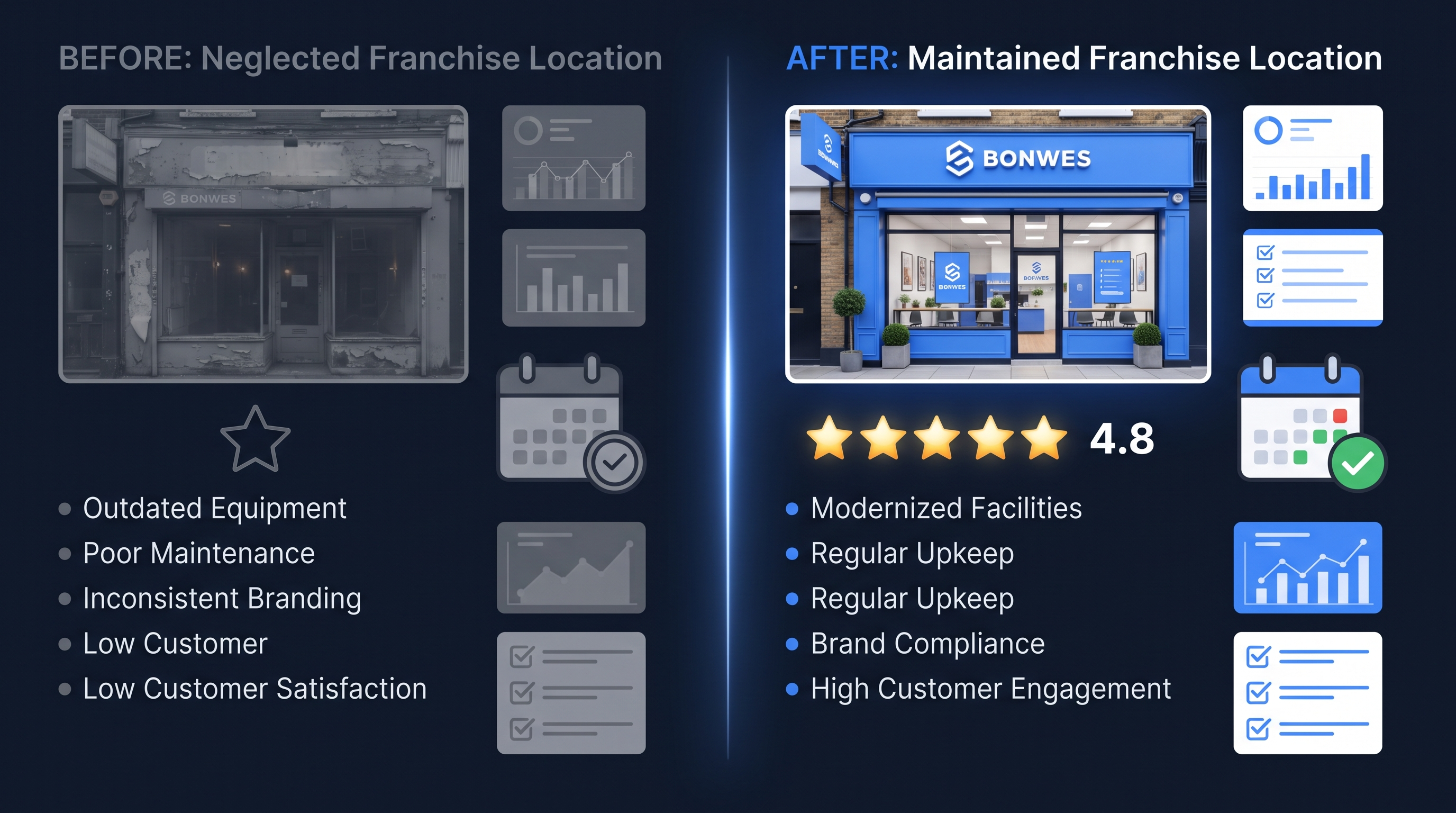
A franchise's national recognition earns the click; the individual location's reviews, photos, and response history earn the visit, because reviews and reputation are literally one of Google's three published ranking factors, prominence, and a customer choosing between two nearby doors is running the same evaluation the algorithm already ran: is this specific location clean, responsive, and open when it claims to be.
A recognizable logo and polished corporate photography get a franchise brand considered. They do not close the decision. A customer scrolling reviews on a phone is not evaluating the brand. They are evaluating whether the location three minutes away is going to answer the phone, show up on time, and look the way the pictures say it looks. That is local proof, and it consistently outweighs national polish in the moment a purchase decision actually gets made.
The mechanics are straightforward. Responding promptly to both positive and negative reviews signals an engaged, active business. Real photos of the storefront, the team, and completed work build more trust than stock imagery ever will, because they answer the one question every searcher is silently asking: what will I actually find when I get there. Regular Google Posts about local promotions or seasonal updates keep the profile visibly alive rather than abandoned.
“Every Own the Map engagement starts with the same instrument: a 49-point geo-grid heatmap scan of each location, run weekly. It tells you exactly where on the map a location disappears and why, three blocks from the door or three miles out, before a single review gets touched. The franchise operators who win local search stopped treating every location's Google profile like a corporate press release and started treating it like a measured asset. Corporate sets the standard once. The grid gets checked every week.”
Adam Silva, Founder & President, Adam Silva Consulting
What Breaks Brand Consistency Across Dozens of Google Business Profiles?
The single most common failure across multi-location brands is NAP inconsistency, name, address, and phone number that does not match exactly between the website, third-party directories, and each location's Google profile, and Google's own guidelines are explicit that mismatched information erodes trust in every listing tied to that brand.
The fix is unglamorous but non-negotiable. Every location should be claimed and verified through an official organizational account, never a personal one an employee happens to control. Naming should follow one real convention across the entire footprint, for example Brand Name, City Center, so both customers and Google can identify each location without guessing. Google's guidelines are direct about business names: they must match what appears on the storefront and official materials, not a keyword-stuffed variant like "Brand Name, Best Cheap Service, City" that manufacturers relevance instead of earning it. That kind of stuffing creates compliance problems and risks the listing itself.
None of this is administrative trivia. A location that says it is open when it is closed has broken a promise before the customer ever reaches the door.
How Does a Google Business Profile Turn a Search Into a Store Visit?
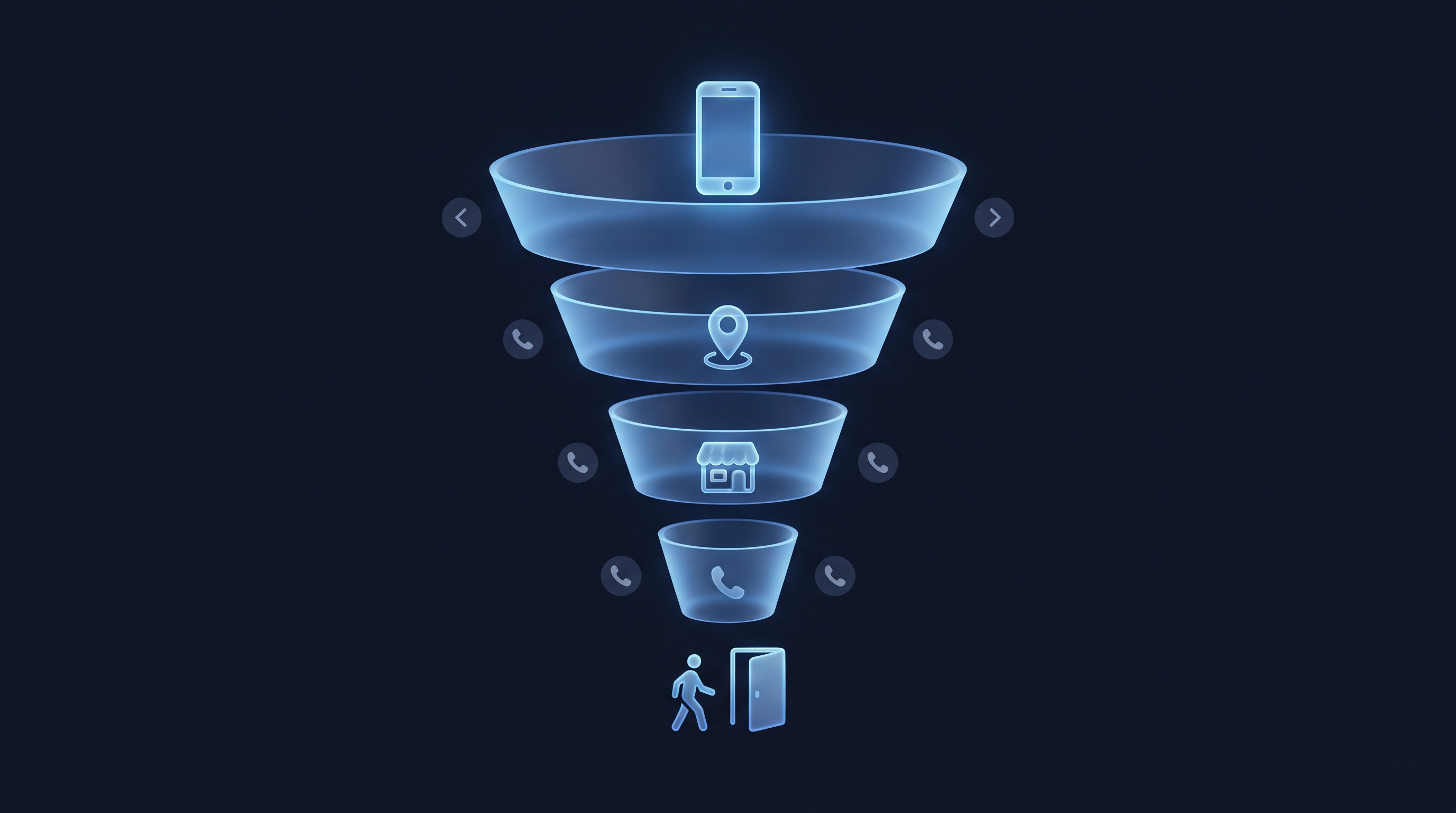
A Google Business Profile functions as a lightweight conversion funnel: one tap for a phone call, one tap for turn-by-turn directions, one tap for booking, removing nearly every step between a search and a paying customer walking through the door.
In many cases, that profile converts foot traffic faster than the corporate website does, precisely because it removes friction the website cannot. A customer does not have to navigate a menu, find a locations page, or hunt for a phone number. Google-commissioned research puts a hard number on the urgency behind this: roughly three out of four consumers who conduct a local search on a smartphone visit a physical location within 24 hours. That 24-hour window is the highest-intent moment a multi-location brand will ever get in front of a customer, and the profile, not the website, is what most of them act on first.
Accurate hours matter more here than almost anywhere else in the marketing stack. Holiday hours, real-time status, and correct booking links prevent the single most avoidable failure in local search: a customer who was ready to buy, arriving to a locked door.
What Should a Multi-Location Brand Do About This Right Now?
Claim and verify every location through an organizational account, run a location-by-location NAP audit, replace corporate stock photography with real location imagery, and assign explicit ownership between corporate and local teams, because the goal is not tricking Google into first place, it is removing every avoidable reason Google or the customer chooses someone else.
A useful amount of local SEO advice implies every ranking problem can be solved with more keywords or more posts. It cannot. What a franchise brand controls is the completeness of each profile, the accuracy of its information, the quality of its photos, and the consistency of its review process. What it does not control is the searcher's exact location, the number of nearby competitors, or every change Google makes to how results are displayed. The strategy is not manipulation. It is removing friction.
- Claim and verify every location under one organizational account, not scattered personal logins.
- Run a five-minute NAP audit per location, confirming name, address, and phone match exactly across Google, the website, and major directories.
- Add LocalBusiness schema markup to each location's page so Google and AI answer engines can parse the address, hours, and category directly, not just infer it from prose.
- Replace at least three stock photos per location with real images of the storefront, entrance, and team.
- Build a standing review-request process so recent, real reviews accumulate without incentives or selective invitations.
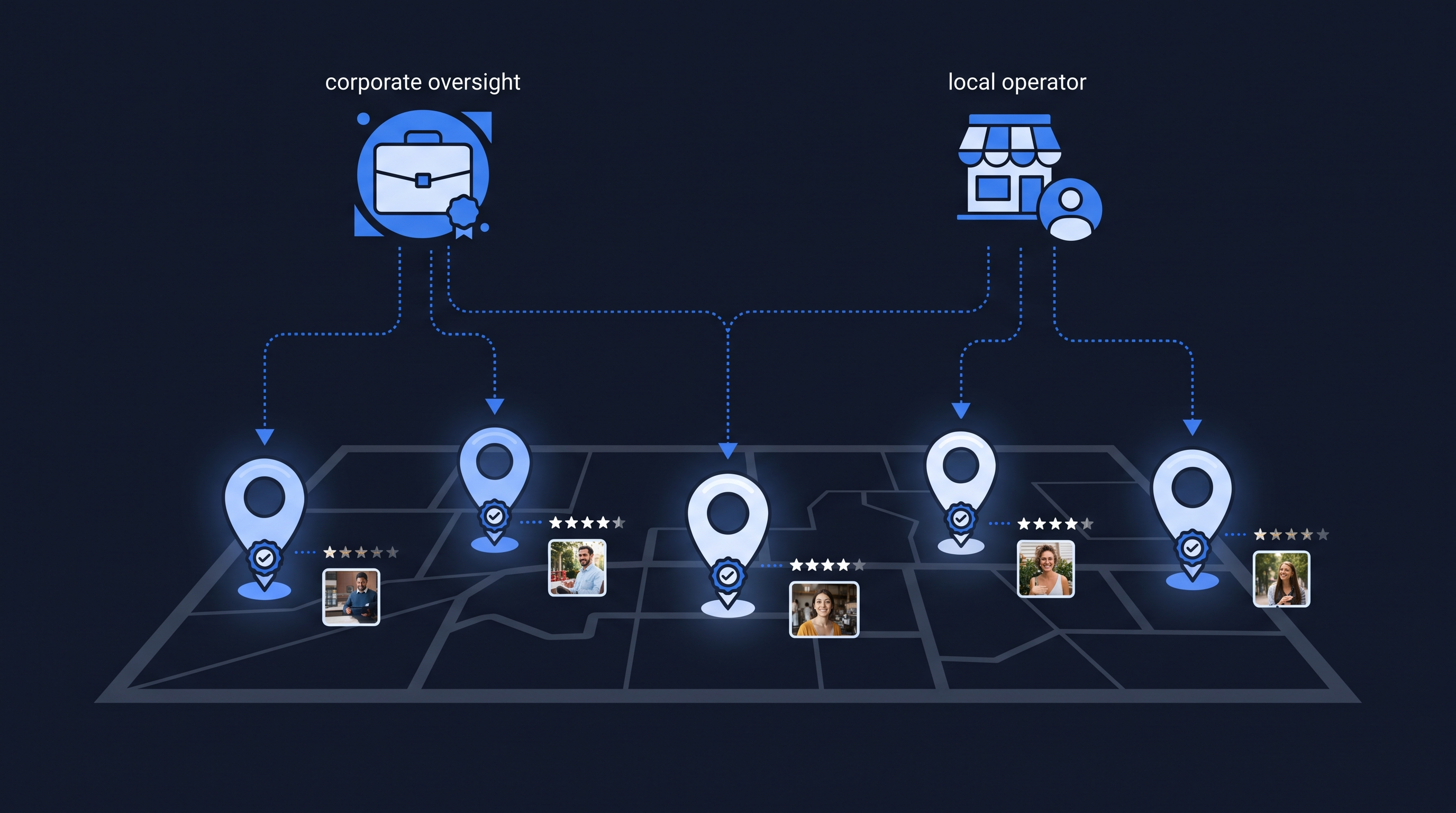
- Assign explicit ownership, corporate for brand standards, local operator for ground-truth accuracy, so no location quietly goes stale.
The distance between a smartphone search and a paying customer has never been shorter. Google Maps has become the growth engine that decides whether a franchise brand delivers on its promise to the neighborhood searching for it right now, one location at a time.
The infrastructure for winning that moment is not complicated, and it is not optional. Every location a franchise brand operates is either an owned, accurate, trusted storefront on the map, or it is a gap a competitor is already filling. The businesses that treat their Google presence as a managed asset, audited, staffed, and current at every address, will keep converting local intent into foot traffic. The ones that leave it on autopilot will spend the next few years wondering why the location down the street, with a worse product, keeps winning the call.
Done-for-you Google Business Profile management. Month to month, no contract. View transparent pricing.
Last Fact-Checked & Metric-Verified: August 2026 · Sources cited inline with publication year
Frequently Asked Questions
What is the Local 3-Pack and why does it matter for multi-location brands?+
The Local 3-Pack is the group of map-based business listings Google shows above traditional web results for searches with local intent, displaying name, rating, hours, and direct-action buttons. For a multi-location franchise, each address competes in its own 3-Pack independently, so brand-wide reputation does not automatically carry over to a specific location.
How does Google decide which franchise location ranks first in local search?+
Google has published that local ranking is determined by relevance, distance, and prominence working together. Distance cannot be optimized once a location is leased, which leaves relevance (an accurate, complete profile) and prominence (reviews, citations, and reputation) as the two levers each individual location actually controls.
Who should manage a franchise location Google Business Profile, corporate or the local operator?+
Both, with a clear split. Corporate should own account access, brand standards, naming conventions, and primary category selection. The local operator should own holiday hours, real photos of the actual site, review responses, and day-to-day accuracy, since ground-truth details change faster than corporate can track centrally.
Why do reviews and photos matter more at the location level than the brand level?+
A national brand earns consideration, but a customer choosing between two nearby locations is deciding whether that specific address is clean, responsive, and open as claimed. Location-specific reviews and real photos answer that question directly, which is why local proof consistently outweighs corporate polish in the final decision.
What is the fastest way for a multi-location brand to improve local visibility?+
Run a NAP audit confirming name, address, and phone match exactly across every profile and directory, then replace generic stock photography with real location images. Both are high-leverage, low-cost fixes. For brands managing this across many locations, Adam Silva Consulting's Own the Map program rebuilds and maintains every profile on a month-to-month basis.
Related Articles
Sources & References
- Google Business Profile Help — "Improve your local ranking on Google" — official documentation naming relevance, distance, and prominence as the three ranking factors for local search resultsSource
- Google Business Profile Help — "Guidelines for representing your business on Google" — business name, category, and NAP accuracy requirements, including prohibition on keyword-stuffed listing namesSource
- Google Business Profile Help — "Verify your business on Google" — verification requirements for organizational account ownership of individual locationsSource
- Think with Google — Consumer research on smartphone "near me" search behavior and the compressed window between local search and in-store visitsSource
- Google Search Central — Structured data documentation for LocalBusiness entities and how local business information is surfaced in Search and MapsSource
- schema.org — LocalBusiness vocabulary for machine-readable business location, hours, and contact dataSource